
Community Perceptions of Human-Long-Tailed Macaque Interactions in Fragmented Urban Landscapes of Palembang
Article Sidebar
-
Coexistence, Macaque, Perception, Fragmentation, Landscape, Tolerance
Abstract
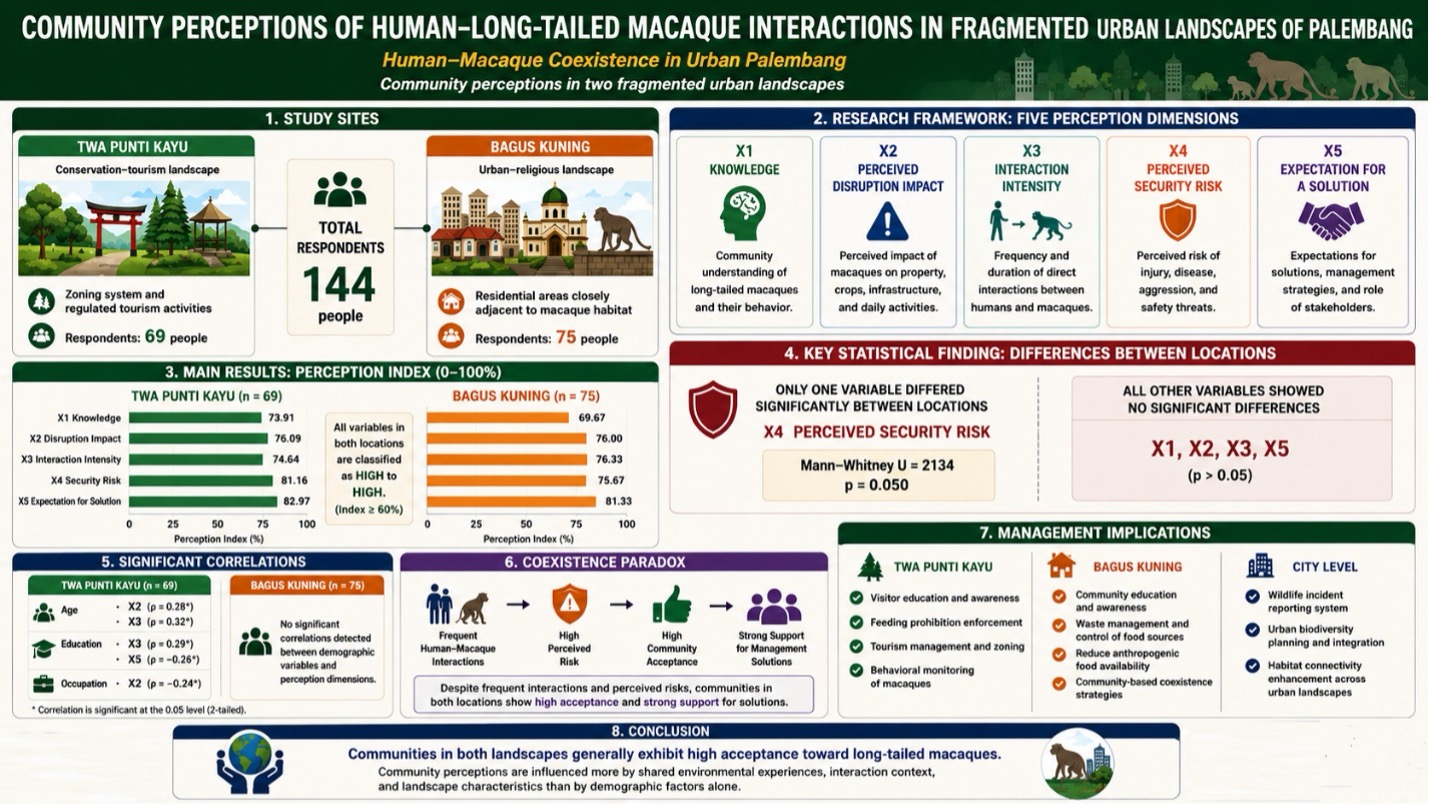
Urban habitat fragmentation promotes interactions between humans and long-tailed macaques (Macaca fascicularis), creating social–ecological challenges for wildlife coexistence. Understanding community perceptions is essential for developing coexistence strategies where human activities and wildlife habitats overlap. This study evaluated community perceptions of long-tailed macaques in two fragmented landscapes, TWA Punti Kayu and Bagus Kuning, Palembang, Indonesia. A structured questionnaire was administered to 144 respondents and assessed five perception dimensions: Knowledge, Perceived Disruption Impact, Interaction Intensity, Perceived Security Risk, and Expectation for a Solution. Perception indices were calculated, while differences between locations were analyzed using the Mann–Whitney U test and relationships between perception variables and ordinal sociodemographic characteristics (age and educational level) were examined using Spearman rank correlation, whereas gender and occupation were analyzed using the Mann–Whitney U and Kruskal–Wallis H tests, respectively. Results indicated positive perceptions, with all dimensions classified as high to very high in both locations. Perceived Security Risk was the only dimension differing significantly between locations (p = 0.050), whereas Knowledge, Perceived Disruption Impact, Interaction Intensity, and Expectation for a Solution showed no significant differences (p > 0.05). Correlation analyses revealed weak associations between sociodemographic characteristics and perception variables, suggesting demographic factors played a limited role in shaping community responses. Instead, shared environmental experiences and interaction contexts appeared to exert greater influence on public perceptions. This study contributes to human-wildlife coexistence literature by integrating social and ecological perspectives. Findings demonstrate that coexistence outcomes are shaped by broader social-ecological conditions associated with habitat fragmentation and human activity patterns. Results emphasize site-specific management, including education, feeding regulation, waste management, community engagement, and urban biodiversity planning, to support sustainable human–macaque coexistence.
References
Balasubramaniam, K. N., S. Malaivijitnond, T. Kemthong, S. Meesawat, Y. Hamada, S. Jeamsripong, J. Srisamran, M. Kuldee, V. Thaotumpitak, B. McCowan, and E. Atwill (2021). Prevalence of Enterobacteriaceae in Wild Long-Tailed Macaques (Macaca fascicularis) in Thailand. International Journal of Primatology, 42(3); 337–341.
Boakes, Z., R. Stafford, I. Bramer, M. Cvitanovi?, and E. A. Hardouin (2023). The Importance of Urban Areas in Supporting Vulnerable and Endangered Mammals. Urban Ecosystems, 27(3); 883–894.
Caparrós-Vallcorba, C., F. V. S. de Abreu, C. Azat, and J. A. Benavides (2026). Global Distribution and Contexts of Interactions Between Humans and Non-Human Primates: A Systematic Review. People and Nature, 8(3); 551–568.
Carter, N., M. A. Williamson, S. Gilbert, S. A. Lischka, L. R. Prugh, J. J. Lawler, A. L. Metcalf, A. L. Jacob, B. J. Beltrán, A. J. Castro, A. Sage, and M. Burnham (2020). Integrated Spatial Analysis for Human-Wildlife Coexistence in the American West. Environmental Research Letters, 15(2); 021001.
Depret, L. and C. Sueur (2025). Management of Coexistence and Conflicts Between Humans and Macaques in Japan. Animals, 15(6); 888.
Dian, N. D., M. A. F. A. Rahim, S. Chan, and Z. M. Idris (2022). Non-Human Primate Malaria Infections: A Review on the Epidemiology in Malaysia. International Journal of Environmental Research and Public Health, 19(13); 7888.
Eckardt, W., D. Tuyisingize, Y. van der Hoek, S. Tolbert, T. S. Stoinski, F. Ndagijimana, B. A. Kaplin, A. Mudakikwa, and K. Lukas (2021). A Partnership to Build Scientific Capacity of Rwanda’s Future Conservationists: The Memoirs Program. American Journal of Primatology, 83(4).
Entezami, M., F. Mustaqqim, E. Morris, E. S. H. Lim, J. M. Prada, and S. J. Paramasivam (2024). Effect of Human Activity and Presence on the Behavior of Long-Tailed Macaques (Macaca fascicularis) in an Urban Tourism Site in Kuala Selangor, Malaysia. Animals, 14(8); 1173.
Ferdin, A. E. J., A. Pathak, M. Kamaludin, B. R. Lamichhane, S. K. Shah, U. C. Aryal, and N. Baskaran (2025). Understanding Residents’ Preferences for Adaptive Capacity in Human-Wildlife Coexistence: A Case Study from Nepal’s Biodiversity Hotspot. European Journal of Wildlife Research, 71(5); 91.
Fernando, S. U., P. V. Udagama, and S. P. Fernando (2022). Effect of Urbanization on Zoonotic Parasite Prevalence in Macaques. International Journal for Parasitology: Parasites and Wildlife, 17; 1–9.
Hansen, M. F., S. Ellegaard, M. M. Moeller, F. M. Van Beest, A. Fuentes, V. A. Nawangsari, C. Grøndahl, M. L. Frederiksen, M. Stelvig, N. M. Schmidt, C. Traeholt, and T. Dabelsteen (2025). Human–Macaque Co-Construction of Behaviours: Sharing Spaces, Sharing Food, Sharing Lives. International Journal of Primatology.
Holzner, A., K. N. Balasubramaniam, B. M. Weiß, N. Ruppert, and A. Widdig (2021). Oil Palm Cultivation Critically Affects Sociality in a Threatened Malaysian Primate. Scientific Reports, 11(1); 10353.
Jayarathne, S. D. Y., C. A. D. Nahallage, and M. A. Huffman (2025). The Costs of Living Side-by-Side with Monkeys: Economic Impacts on Commercial Farms and Property by Toque Macaques and Proposed Deterrent Strategies in Sri Lanka. Animals, 15(3); 366.
Kaewchot, S., S. Tangsudjai, L. Sariya, C. Mongkolphan, A. Saechin, R. Sariwongchan, N. Panpeth, S. Thongsahuan, and P. Suksai (2022). Zoonotic Pathogens Survey in Free-Living Long-Tailed Macaques in Thailand. International Journal of Veterinary Science and Medicine, 10(1); 11–18.
Karimullah, K., A. Widdig, S. A. M. Sah, and F. Amici (2022). Understanding Potential Conflicts Between Human and Non-Human Primates: A Large-Scale Survey in Malaysia. Biodiversity and Conservation, 31(4); 1249–1266.
Lee, S. X. T., Z. Amir, J. H. Moore, K. M. Gaynor, and M. S. Luskin (2024). Effects of Human Disturbances on Wildlife Behaviour and Consequences for Predator–Prey Overlap in Southeast Asia. Nature Communications, 15(1); 1521.
Ligue-Sabio, K. D., A. R. Plaza, B. Sabanal, G. F. Oguis, J. Torrefiel, and L. E. Gamalo (2026). Spatiotemporal Patterns of Behavior by Long-Tailed Macaques Macaca fascicularis (Raffles 1821) in a Human-Modified Environment. Discover Conservation, 3(1); 3.
Ma, D., B. Abrahms, J. E. Allgeier, Y. Malhi, and N. H. Carter (2024). Global Expansion of Human-Wildlife Overlap in the 21st Century. Science Advances, 10(34); eadp7706.
Ma, J., J. Li, W. Wu, and J. Liu (2023). Global Forest Fragmentation Change from 2000 to 2020. Nature Communications, 14(1).
Marty, P. R., K. N. Balasubramaniam, S. S. K. Kaburu, J. Hubbard, B. Beisner, E. Bliss-Moreau, N. Ruppert, M. E. Arlet, S. A. Mohd Sah, A. Ismail, L. Mohan, S. K. Rattan, U. Kodandaramaiah, and B. McCowan (2020). Individuals in Urban Dwelling Primate Species Face Unequal Benefits Associated with Living in an Anthropogenic Environment. Primates, 61(2); 249–255.
Moesch, S., T. Straka, J. Jeschke, D. Haase, and S. Kramer-Schadt (2024). The Good, the Bad, and the Unseen: Wild Mammal Encounters Influence Wildlife Preferences of Residents Across Socio-Demographic Gradients. Ecology and Society, 29(3); art6.
Ngo, K. M., T. Hosaka, and S. Numata (2022). Attitudes and Preferences of Wildlife and Their Relationship with Childhood Nature Experience Amongst Residents in a Tropical Urban City. Urban Ecosystems, 25; 1427–1438.
Patouillat, L., A. Hambuckers, S. Adi Subrata, M. Garigliany, and F. Brotcorne (2024). Zoonotic Pathogens in Wild Asian Primates: A Systematic Review Highlighting Research Gaps. Frontiers in Veterinary Science, 11.
Poornima, A., W. Weerasekara, M. Vinobaba, and R. Sivashankar (2022). Community-Level Awareness and Attitudes Towards Human-Monkey Conflict in Polonnaruwa District, Sri Lanka. Primates, 63; 581–590.
Puri, M., K. O. Goode, K. L. Johannsen, and E. F. Pienaar (2024). Engaging Urban Residents in the Appropriate Actions to Mitigate Human-Wildlife Conflicts. Conservation Science and Practice, 6(1); e13074.
Radhakrishna, S., S. Anand, and A. Sengupta (2025). Differing Trajectories: Understanding Coexistence through the Human-Macaque Interface in India. International Journal of Primatology, 46(6); 1276–1290.
Setia, M. S. (2016). Methodology Series Module 3: Cross-Sectional Studies. Indian Journal of Dermatology, 61(3); 261–264.
Spaan, D., G. Ramos-Fernández, M. Bonilla-Moheno, C. M. Schaffner, J. E. Morales-Mávil, K. Slater, and F. Aureli (2020). Anthropogenic Habitat Disturbance and Food Availability Affect the Abundance of an Endangered Primate: A Regional Approach. Mammalian Biology, 100(3); 325–333.
Stevens, M., S. Rawat, and T. Satterfield (2025). Care, Conflict, and Coexistence: Human-Wildlife Relations in Community Forests. People and Nature, 7(1); 231–246.
Tampakis, S., V. Andrea, T. Panagopoulos, P. Karanikola, R. Gkarmiri, and T. Georgoula (2023). Managing the Conflict of Human-Wildlife Coexistence: A Community-Based Approach. Land, 12(4); 832.
Thatcher, H. R. and C. T. Downs (2021). The Costs of Urban Living: Human–Wildlife Interactions Increase Parasite Risk and Self-Directed Behaviour in Urban Vervet Monkeys. Journal of Urban Ecology, 7(1); juab031.
Thatcher, H. R., C. T. Downs, and N. F. Koyama (2023). Primates in the Urban Mosaic: Terminology, Flexibility, and Management. In T. McKinney, S. Waters, and M. A. Rodrigues, editors, Primates in Anthropogenic Landscapes: Exploring Primate Behavioural Flexibility Across Human Contexts. Springer, pages 121–137.
Zhang, X., W. Wan, and R. C. Estoque (2025). Impacts of Urban and Cropland Expansions on Natural Habitats in Southeast Asia. Nature Communications, 16(1); 8479.
Zhang, Y., W. Ming, Z. Chen, X. Gao, S. Long, X. Shang, L. Dong, S. Li, and L. Zhang (2026). Beyond Compensation: Governing Human-Wildlife Coexistence under Climate and Land-Use Change. Ambio; 1–19.
Zhao, Y. Y., A. Wong, S. Alsisto, I. Matsuda, and H. Bernard (2023). Long-Tailed Macaque Reliance on Anthropogenic Food with Potential Conflicts Toward Humans in the Campus of Universiti Malaysia Sabah. Mammal Study.
Zou, Y., T. W. Crowther, G. R. Smith, H. Ma, L. Mo, L. Bialic-Murphy, P. Potapov, K. A. Gawecka, C. Xu, P. J. Negret, T. B. Lauber, Z. Wu, D. Rebindaine, and C. M. Zohner (2025). Fragmentation Increased in Over Half of Global Forests from 2000 to 2020. Science, 389(6765); 1151–1156.