
Synergistic Valorization of Palm Oil Mill Effluent and Boiler Ash into a Nutrient-Rich Liquid Organic Fertilizer
Article Sidebar
-
Waste Valorization, Palm Oil Mill Effluent, Boiler Ash, Liquid Organic Fertilizer, Industrial Symbiosis, Circular Economy
Abstract
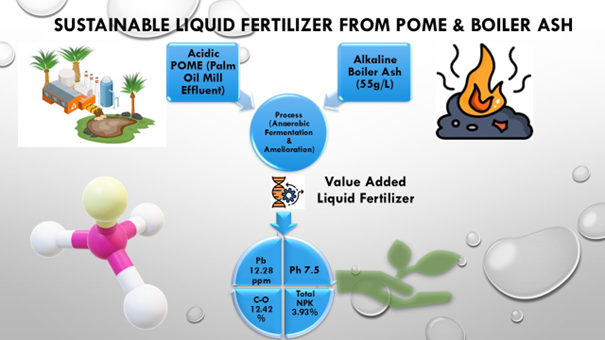
Industrial symbiosis presents a transformative pathway for the sustainable management of palm oil byproducts. This study investigates a novel integrated valorization approach using boiler ash as a multifunctional ameliorant in the anaerobic fermentation of palm oil mill effluent (POME). By leveraging the synergistic physicochemical properties of acidic POME and alkaline boiler ash, we developed a self-buffering system to produce high-value liquid organic fertilizer. Varying boiler ash concentrations (0, 45, 50, and 55 g/L) were evaluated to determine the optimal nutrient recovery and stabilization parameters. Results demonstrate that a dosage of 55 g/L is statistically superior, effectively neutralizing the system to a stable pH of 7.5 without synthetic additives. This treatment yielded a nutrient-dense product containing 3.93% total NPK and 12.42% organic carbon, surpassing the Indonesian Ministry of Agriculture Regulation No. 261/2019 standards. Safety analysis revealed a Pb concentration of 12.28 ppm, which is significantly below the maximum allowable threshold, confirming the product’s environmental compatibility. This research provides a scientifically grounded method for converting industrial waste into a fortified agricultural input, advancing circular economy principles and supporting national sustainability frameworks like the Indonesia Sustainable Palm Oil (ISPO) certification.
References
Badan Pusat Statistik (2024). Indonesian Oil Palm Statistics 2023. 5504003. Badan Pusat Statistik, Jakarta. Publication Number: 05100.24024; Released November 29, 2024; Language: Indonesian and English
Euniza Jusli, M., D. I. Jen Hua Ling, M. Mastura Bujang, and M. Dayang Siti Hazimmah Ali (2022). Physical and Chemical Properties of Palm Oil Boiler Ash and Palm Oil Clinker Powder. Borneo Journal of Sciences & Technology, 4(1); 1–5
Firdaus, T. and F. L. N. Alifiyah (2025). Circular Economy in the Palm Oil Industry: Global Trends, Potentials, and Opportunities for Green Economy In Indonesia. International Journal of Oil Palm, 8(2); 1–16
Hamzah, M. H., M. F. Ahmad Asri, H. Che Man, and A. Mohammed (2019). Prospective Application of Palm Oil Mill Boiler Ash As a Biosorbent: Effect of Microwave Irradiation and Palm Oil Mill Effluent Decolorization by Adsorption. International Journal of Environmental Research and Public Health, 16(18); 3453
Jijingi, H. E., S. K. Yazdi, Y. A. Abakr, and A. D. M. Satya (2025). Bioremediation of Heavy Metals in Palm Oil Mill Effluent (POME) Using Chlorella vulgaris: A Biological Approach. Cleaner Water, 4; 100094
Judijanto, L. (2025). A Review of Palm Oil Valorization Technologies. International Journal of Engineering, Science and Information Technology, 5(4); 172–180
Lal, R. (2021). Soil Organic Carbon and Feeding the Future: Basic Soil Processes. CRC Press
Li, M., S. Li, S. Chen, Q. Meng, Y. Wang, W. Yang, L. Shi, F. Ding, J. Zhu, and R. Ma (2023). Measures for Controlling Gaseous Emissions during Composting: A Review. International Journal of Environmental Research and Public Health, 20(4); 3587
Lionel, I., A. Ro’uf, and B. Alldino (2023). Analisis Spesifisitas Terhadap Sensor NPK. IJEIS (Indonesian Journal of Electronics and Instrumenations Systems), 13(1); 45–56 (in Indonesia)
Mariska, R., M. Faisal, C. M. Rosnelly, and E. Mirda (2024). Characteristics of Liquid Waste-Derived Organic Fertilizer Enriched With Oil Palm Empty Fruit Bunches Ash Through Anaerobic Fermentation. Elkawnie: Journal of Islamic Science and Technology, 10(2); 318–333
Mondamina, N. W., D. Rachmat, and M. W. T. Laksono (2020). Alternative Scenarios to Utilise Excess Biogas in Palm Oil Mill. Indonesian Journal of Environmental Management and Sustainability, 4(2); 48–54
Ofon, U. A., U. U. Ndubuisi-Nnaji, O. K. Fatunla, O. D. Akan, S. E. Shaibu, N.-A. O. Offiong, I. Y. Sandy, E. J. Egong, and N. D. Ibuotenang (2024). Emerging Trends in Pome Treatment and Applications: Chemical and Biotechnological Aspects. Journal of Materials & Environmental Sustainability Research, 4(1); 11–44
Phibunwatthanawong, T. and N. Riddech (2019). Liquid Organic Fertilizer Production for Growing Vegetables under Hydroponic Condition. International Journal of Recycling of Organic Waste in Agriculture, 8(4); 369–380
Putro, L. H. S. (2022). Emissions of CH4 and CO2 from Wastewater of Palm Oil Mills: A Real Contribution to Increase the Greenhouse Gas and Its Potential as Renewable Energy Sources: 10.32526/ennrj/20/202100149. Environment and Natural resources journal, 20(1); 61–72
Rahmawati, N. (2023). Respons Pertumbuhan Bibit Kelapa Sawit (Elaeis guineensis Jacq.) terhadap Pemberian Abu Boiler dan Pupuk Organik Cair (POC) Azolla microphylla di Pembibitan Utama
Razman, K. K., M. M. Hanafiah, A. W. Mohammad, and A. W. Lun (2022). Life Cycle Assessment of an Integrated Membrane Treatment System of Anaerobic-Treated Palm Oil Mill Effluent (pome). Membranes, 12(2); 246
Rezwan, F., M. A. Kashem, H. Hu, and M. S. Islam (2024). Mechanisms of Metal Immobilization in the Soil by a Phosphate Compound with Low Molecular Weight Organic Acids Present. Communications in Soil Science and Plant Analysis, 55(16); 2422–2443
Saad, M. S., N. C. Joe, H. A. Shuib, M. D. H. Wirzal, Z. A. Putra, M. R. Khan, and R. Busquets (2022). Techno-Economic Analysis of an Integrated Electrocoagulation-Membrane System in Treatment of Palm Oil Mill Effluent. Journal of King Saud University-Science, 34(4); 102015
Setiawan, A. F., A. Haryanto, U. Hasanudin, S. Triyono, and D. A. Iryani (2025). Biogas Production from Palm Oil Mill Effluent and the Prospect of Co-digestion with Empty Fruit Bunches ˆa€“A Comprehensive Review. Jurnal Teknik Pertanian Lampung (Journal of Agricultural Engineering), 14(5); 1976–2005
Siagian, U. W. R., I. G. Wenten, K. Khoiruddin, et al. (2024). Circular Economy Approaches in the Palm Oil Industry: Enhancing Profitability through Waste Reduction and Product Diversification. Journal of Engineering and Technological Sciences, 56(1); 25–49
Sun, L., C. Yao, A. Guo, and Z. Yu (2023). A Review on the Application of Lignocellulosic Biomass Ash in Cement-Based Composites. Materials, 16(17); 5997
Tandiono, J., H. Thamrin, and T.Warningsih (2025). Impact of Using Boiler Ash as Soil Ameliorant and Nitrogen Fertilizer on CO2 Emission in Oil Palm Plantations on Peat Soil. Pertanika Journal of Tropical Agricultural Science, 48(2); 653–665
Tiquia, S. (2002). Microbial Transformation of Nitrogen during Composting. In Microbiology of Composting. Springer, pages 237–245
UNEP (2024). Global Waste Management Outlook 3: The Future of Resource Management
Wu, T. Y., A. W. Mohammad, J. M. Jahim, and N. Anuar (2009). A Holistic Approach to Managing Palm Oil Mill Effluent (POME): Biotechnological Advances in the Sustainable Reuse of POME. Biotechnology Advances, 27(1); 40–52
Xiao, R., M. K. Awasthi, R. Li, J. Park, S. M. Pensky, Q. Wang, J. J. Wang, and Z. Zhang (2017). Recent Developments in Biochar Utilization As an Additive in Organic Solid Waste Composting: A Review. Bioresource Technology, 246; 203–213
Yang, Z., F. Muhayodin, O. C. Larsen, H. Miao, B. Xue, and V. S. Rotter (2021). A Review of Composting Process Models of Organic Solid Waste with a Focus on the Fates of C, N, P, and K. Processes, 9(3); 473