Low-Carbon and Environmentally Sustainable Aquaculture in Coastal Ecosystems: A Systematic Literature Review
Article Sidebar
-
Low-Carbon Aquaculture, Integrated Multi-Trophic Aquaculture, Coastal Ecosystem Restoration, Sustainability Indicators, Climate Resilience
Abstract
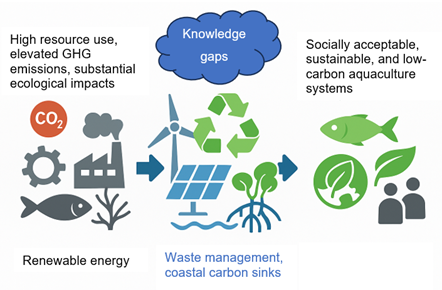
Low-carbon aquaculture is increasingly recognized as a vital strategy to mitigate climate change, improve resource efficiency, and ensure sustainable food production. This systematic review, following the PRISMA 2020 protocol, analyzed 58 peer-reviewed studies selected from 312 published between 2020-2024, providing a transparent and replicable synthesis of the current evidence. Research is predominantly focused in Asia and Europe, regions where rapid aquaculture growth coincides with emerging climate policies. Key strategies for reducing environmental impacts include Integrated Multi-Trophic Aquaculture (IMTA), cultivation of low-trophic species such as seaweeds and filter feeders, and the restoration of coastal ecosystems, all of which enhance carbon sequestration, nutrient cycling, and ecosystem resilience. The review identifies the most commonly reported sustainability indicators as global warming potential (GWP), energy consumption, land use, nutrient loading, and eutrophication. Despite ongoing technological innovations, global aquaculture remains largely unsustainable with persistently low environmental performance. Barriers to improvement include incomplete carbon accounting, fragmented regulatory frameworks, and limited consumer awareness. Additionally, significant knowledge gaps in greenhouse gas emissions and carbon sequestration constrain robust life cycle assessments. Transitioning to low-carbon aquaculture requires not only technological innovation but also with stronger governance, ecosystem-based management, and integrated policy frameworks to enhance sustainability and climate resilience. This review underscores the urgency of coordinated action across research, industry, and policy sectors to optimize low-carbon strategies, address existing knowledge gaps, and support the development of sustainable aquaculture systems that are both environmentally responsible and economically viable.
References
Algozeeb, W. A., P. E. Savas, Z. Yuan, Z. Wang, C. Kittrell, J. N. Hall, W. Chen, P. Bollini, and J. M. Tour (2022). Plastic Waste Product Captures Carbon Dioxide in Nanometer Pores. ACS nano, 16(5); 7284–7290
Badiola, M., B. Albaum, R. Curtin, I. Gartzia, and D. Mendiola (2017). Land-Based On-Growing of Atlantic Cod (Gadus morhua) Using Recirculating Aquaculture Systems: A Case Study from the Basque Region (Northern Spain). Aquaculture, 468; 428–441
Bashir, T., S. Zafar, and S. Bashir (2022). Phytoremediation of Micropollutants. In Environmental Micropollutants. Elsevier, pages 365–386
Bennett, M., A. March, and P. Failler (2023). Blue Farming Potentials: Sustainable Ocean Farming Strategies in the Light of Climate Change Adaptation and Mitigation. Green and Low-Carbon Economy, 2(2); 71–86
Biswas, G., P. Kumar, T. Ghoshal, M. Kailasam, D. De, A. Bera, B. Mandal, K. Sukumaran, and K. Vijayan (2020). Integrated Multi-Trophic Aquaculture (IMTA) Outperforms Conventional Polyculture with Respect to Environmental Remediation, Productivity and Economic Return in Brackishwater Ponds. Aquaculture, 516; 734626
Bjørkan, M. and S. M. Eilertsen (2020). Local Perceptions of Aquaculture: A Case Study on Legitimacy from Northern Norway. Ocean & coastal management, 195; 105276
Bohnes, F. A. and A. Laurent (2021). Environmental Impacts of Existing and Future Aquaculture Production: Comparison of Technologies and Feed Options in Singapore. Aquaculture, 532; 736001
Briones-Hidrovo, A., P. Quinteiro, and A. C. Dias (2023). Investigating the Environmental Sustainability of a Seabass and Seabream Aquaculture System in Portugal Based on Life Cycle and Nexus Approaches. Science of the Total Environment, 890; 164195
Camelo-Guarin, S., C. Molinet, and D. Soto (2021). Recommendations for Implementing Integrated Multitrophic Aquaculture in Commercial Farms at the Landscape Scale in Southern Chile. Aquaculture, 544; 737116
Chen, G., J. Bai, C. Bi, Y. Wang, and B. Cui (2023). Global Greenhouse Gas Emissions from Aquaculture: A Bibliometric Analysis. Agriculture, Ecosystems & Environment, 348; 108405
Cutajar, K., L. Falconer, A. Massa-Gallucci, R. E. Cox, L. Schenke, T. Bardócz, C. Andolina, G. Signa, S. Vizzini, M. Sprague, et al. (2022). Stable Isotope and Fatty Acid Analysis Reveal the Ability of Sea Cucumbers to Use Fish Farm Waste in Integrated Multi-Trophic Aquaculture. Journal of environmental management, 318; 115511
Das, S. K., K. T. Selvan, N. M. Noor, M. De, and D. S. Francis (2023). Effects of Dissolved Carbon Dioxide on Growth and Vertebral Column of Hybrid Marine Grouper (Epinephelus fuscoguttatus × E. Lanceolatus) Early Advanced Larvae. Journal of Sea Research, 193; 102381
de Godoy, E. M., F. S. David, N. S. Fialho, D. C. Proenca, T. R. Camargo, and G. W. Bueno (2022). Environmental Sustainability of Nile Tilapia Production on Rural Family Farms in the Tropical Atlantic Forest Region. Aquaculture, 547; 737481
Dubuc, A., J. Rummer, L. Vigliola, and H. Lemonnier (2024). Coping with Environmental Degradation: Physiological and Morphological Adjustments of Wild Mangrove Fish to Decades of Aquaculture-Induced Nutrient Enrichment. Marine Pollution Bulletin, 205; 116599
Edwards, M. R., Z. H. Thomas, G. F. Nemet, S. Rathod, J. Greene, K. Surana, K. M. Kennedy, J. Fuhrman, and H. C. McJeon (2024). Modeling Direct Air Carbon Capture and Storage in a 1.5? C Climate Future Using Historical Analogs. Proceedings of the National Academy of Sciences, 121(29); e2215679121
Elkhlifi, Z., J. Iftikhar, M. Sarraf, B. Ali, M. H. Saleem, I. Ibranshahib, M. D. Bispo, L. Meili, S. Ercisli, E. Torun Kayabasi, et al. (2023). Potential Role of Biochar on Capturing Soil Nutrients, Carbon Sequestration and Managing Environmental Challenges: A Review. Sustainability, 15(3); 2527
Ende, S., J. Henjes, M. Spiller, M. Elshobary, D. Hanelt, and A. Abomohra (2024). Recent Advances in Recirculating Aquaculture Systems and Role of Microalgae to Close System Loop. Bioresource Technology, 407; 131107
Flefil, N. S., A. Ezzat, A. M. Aboseif, and A. Negm El-Dein (2022). Lactobacillus-Fermented Wheat Bran, as an Economic Fish Feed Ingredient, Enhanced Dephytinization, Micronutrients Bioavailability, and Tilapia Performance in a Biofloc System. Biocatalysis and Agricultural Biotechnology, 45; 102521
Food and Agriculture Organization of the United Nations (2024). World Fisheries and Aquaculture in Review, volume 35 of Nature and Resources. FAO, Rome, Italy
Frohlich, M., P. Fidelman, I. Dutton, M. Haward, B. W. Head, D. Maynard, D. Rissik, and J. Vince (2023). A Network Approach to Analyse Australia’s Blue Economy Policy and Legislative Arrangements. Marine Policy, 151; 105588
Garavelli, L., M. C. Freeman, L. Tugade, D. Greene, and J. McNally (2022). A Feasibility Assessment for Co-Locating and Powering Offshore Aquaculture With Wave Energy in the United States. Ocean & Coastal Management, 225; 106242
Gou, R., J. Feng, H. Zhou, T. Lang, J. Zhao, L. Mo, S. Song, and G. Lin (2024). CO2 Fluxes Contrast Between Aquaculture Ponds and Mangrove Forests and Its Implications for Coastal Wetland Rehabilitation in Leizhou Peninsula, China. Agriculture, Ecosystems & Environment, 367; 108968
Jiang, Q., N. Bhattarai, M. Pahlow, and Z. Xu (2022). Environmental Sustainability and Footprints of Global Aquaculture. Resources, Conservation & Recycling, 180; 106183
Kiviranta, K., T. Thomasson, J. Hirvonen, and M. Tähtinen (2020). Connecting Circular Economy and Energy Industry: A Techno-Economic Study for the Åland Islands. Applied Energy, 279; 115883
Kouhgardi, E., S. Zendehboudi, O. Mohammadzadeh, A. Lohi, and I. Chatzis (2023). Current Status and Future Prospects of Biofuel Production from Brown Algae in North America: Progress and Challenges. Renewable and Sustainable Energy Reviews, 172; 113012
Kousik, S. and M. Samykano (2025). Challenges and Prospectives of Energy Storage Integration in Renewable Energy Systems for Net Zero Transition. Journal of Energy Storage, 125; 116923
Kraly, P., J. Weitzman, and R. Filgueira (2022). Understanding Factors Influencing Social Acceptability: Insights from Media Portrayal of Salmon Aquaculture in Atlantic Canada. Aquaculture, 547; 737497
Krogdahl, Å., A. K. G. Hansen, T. M. Kortner, I. Björkhem, A. Krasnov, G. M. Berge, and V. Denstadli (2020). Choline and Phosphatidylcholine, but Not Methionine, Cysteine, Taurine and Taurocholate, Eliminate Excessive Gut Mucosal Lipid Accumulation in Atlantic Salmon (Salmo salar L.). Aquaculture, 528; 735552
Kurniawan, S. B., A. Ahmad, M. F. Imron, S. R. S. Abdullah, A. R. Othman, and H. A. Hasan (2022). Potential of Microalgae Cultivation Using Nutrient-Rich Wastewater and Harvesting Performance by Biocoagulants/Bioflocculants: Mechanism, Multi-Conversion of Biomass into Valuable Products, and Future Challenges. Journal of Cleaner Production, 365; 132806
Lavaud, R., D. S. Ullman, C. Venolia, C. Thornber, L. Green-Gavrielidis, and A. Humphries (2023). Production Potential of Seaweed and Shellfish Integrated Aquaculture in Narragansett Bay (Rhode Island, U.S.) Using an Ecosystem Model. Ecological Modelling, 481; 110370
Li, H., N. Isaac, K. Shen, J. Cheng, J. Xiang, L. Bao, X. Zhu, Y. Pan, W. Chu, Q. Luo, and J. Zhang (2024). Dietary Lipid-Induced Changes in Antioxidant Status, Lipid Metabolism and Flesh Quality of Juvenile Rice Flower Carp (Cyprinus carpio). Aquaculture Reports, 35; 101967
Liu, H. F., X. Ren, B. Xue, C. W. Bi, Y. P. Zhao, and Y. Liu (2023). Systematic Optimization of the Square Arc Angle Aquaculture Tank Combining CFD Methodology and Multi-Objective Genetic Algorithm. Aquacultural Engineering, 101; 102326
Lotze, H. K. (2021). Marine Biodiversity Conservation. Current Biology, 31(19); R1190–R1195
Merk, C., J. Grunau, M. C. Riekhof, and W. Rickels (2022). The Need for Local Governance of Global Commons: The Example of Blue Carbon Ecosystems. Ecological Economics, 201; 107581
Monsalve, E. R. and E. Quiroga (2022). Farmed Shrimp Aquaculture in Coastal Wetlands of Latin America: A Review of Environmental Issues. Marine Pollution Bulletin, 183; 113956
Nisar, U., D. Peng, Y. Mu, and Y. Sun (2022). A Solution for Sustainable Utilization of Aquaculture Waste: A Comprehensive Review of Biofloc Technology and Aquamimicry. Frontiers in Nutrition, 8; 791738
Nissar, S., Y. Bakhtiyar, M. Y. Arafat, S. Andrabi, Z. A. Mir, N. A. Khan, and S. Langer (2023). The Evolution of Integrated Multi-Trophic Aquaculture in Context of Its Design and Components Paving Way to Valorization via Optimization and Diversification. Aquaculture, 565; 739074
Page, M. J., J. E. McKenzie, P. M. Bossuyt, I. Boutron, T. C. Hoffmann, C. D. Mulrow, L. Shamseer, J. M. Tetzlaff, and D. Moher (2021). Updating Guidance for Reporting Systematic Reviews: Development of the PRISMA 2020 Statement. Journal of Clinical Epidemiology, 134; 103–112
Palacios, M. M., S. M. Trevathan-Tackett, M. E. Malerba, and P. I. Macreadie (2021). Effects of a Nutrient Enrichment Pulse on Blue Carbon Ecosystems. Marine Pollution Bulletin, 165; 112024
Pringle, A. M., R. M. Handler, and J. M. Pearce (2017). Aquavoltaics: Synergies for Dual Use of Water Area for Solar Photovoltaic Electricity Generation and Aquaculture. Renewable and Sustainable Energy Reviews, 80; 572–584
Raja, K., K. Suresh, S. Anbalagan, Y. P. Ragini, and V. Kadirvel (2024). Investigating the Nutritional Viability of Marine-Derived Protein for Sustainable Future Development. Food Chemistry, 448; 139087
Rasool, M. H. and S. A. M. Hashmi (2025). Carbon Capture and Storage: An Evidence-Based Review of its Limitations and Missed Promises. Petroleum Research, xxx; 1–30
Riisager-Simonsen, C., G. Fabi, L. van Hoof, N. Holmgren, G. Marino, and D. Lisbjerg (2022). Marine Nature-Based Solutions: Where Societal Challenges and Ecosystem Requirements Meet the Potential of Our Oceans. Marine Policy, 144; 105198
Rosa, J., M. F. L. Lemos, D. Crespo, M. Nunes, A. Freitas, F. Ramos, M. Â. Pardal, and S. Leston (2020). Integrated Multitrophic Aquaculture Systems: Potential Risks for Food Safety. Trends in Food Science & Technology, 96; 79–90
Ruseva, T., J. Hedrick, G. Marland, H. Tovar, C. Sabou, and E. Besombes (2020). Rethinking Standards of Permanence for Terrestrial and Coastal Carbon: Implications for Governance and Sustainability. Current Opinion in Environmental Sustainability, 45; 69–77
Saidin, S., I. Supriatna, and R. Rusli (2025). Growth Pattern Analysis of Whiteleg Shrimp (Litopenaeus vannamei) in an Intensive Aquaculture System at the Busmetik Pond, Sorong City, Southwest Papua. Jurnal Sains Akuakultur Tropis, 9(2); 221–229
Saikia, S. K. (2024). Aquatic Resources and Feed Diversification: Reviewing Three Case Studies from South East Asia with a Viewpoint of Trophic Intensification in Rice–Fish Culture. Aquaculture and Fisheries, 9(4); 501–510
Sánchez-Jerez, P., J. M. F. Babarro, X. A. Padin, A. Longa Portabales, S. Martinez-Llorens, J. D. Ballester-Berman, G. Sarà, and M. C. Magano (2022). Cumulative Climatic Stressors Strangles Marine Aquaculture: Ancillary Effects of COVID-19 on Spanish Mariculture. Aquaculture, 549; 737749
Sandison, F., J. Hillier, A. Hastings, P. Macdonald, B. Mouat, and C. T. Marshall (2021). The Environmental Impacts of Pelagic Fish Caught by Scottish Vessels. Fisheries Research, 236; 105850
Schultz, K. M., S. B. Scyphers, A. R. Hughes, D. L. Kimbro, S. Kirk, and J. H. Grabowski (2024). Addressing Constraints to Shellfish Aquaculture Through Quantifying Public Perceptions and Attitudes Along the Atlantic Coast of the US. Ocean & Coastal Management, 253; 107130
Skifa, I., N. Chauchat, P.-H. Cocquet, and Y. Le Guer (2025). Microalgae Cultivation in Raceway Ponds: Advances, Challenges, and Hydrodynamic Considerations. EFB Bioeconomy Journal, 5; 100073
Soares, M. S., R. Singh, S. Kumar, R. Jha, J. Nedoma, R. Martinek, and C. Marques (2024). The Role of Smart Optical Biosensors and Devices on Predictive Analytics for the Future of Aquaculture Systems. Optics and Laser Technology, 177; 111049
Sun, J., N. Li, P. Yang, Y. Zhang, Y. Yuan, X. Lu, and H. Zhang (2020). Simultaneous Antibiotic Degradation, Nitrogen Removal and Power Generation in a Microalgae–Bacteria Powered Biofuel Cell Designed for Aquaculture Wastewater Treatment and Energy Recovery. International Journal of Hydrogen Energy, 45(18); 10871–10881
Sun, L., H. Zhao, and C. Yang (2025). Oyster Farming Helps Reducing China’s Greenhouse Gas Emissions for Food Production. Cleaner Engineering and Technology, 26; 100963
Sutherland, J. F. J. and J. Armbrecht (2024). Media Representation of Aquaculture in Sweden. Aquaculture, 583; 740578
Taslim, I., S. Basuni, M. Y. J. Purwanto, and I. P. Santikayasa (2025). Driving Factors Influencing Watershed Management and Sustainability: A Systematic Review. Indonesian Journal of Environmental Management and Sustainability, 9(3); 115–133
Tchonkouang, R. D., H. Onyeaka, and H. Nkoutchou (2024). Assessing the Vulnerability of Food Supply Chains to Climate Change-Induced Disruptions. Science of the Total Environment, 920; 171047
Tian, W., Q. Li, Z. Luo, C. Wu, B. Sun, D. Zhao, S. Chi, Z. Cui, A. Xu, and Z. Song (2024). Microbial Community Structure in a Constructed Wetland Based on a Recirculating Aquaculture System: Exploring Spatio-Temporal Variations and Assembly Mechanisms. Marine Environmental Research, 197; 106413
Tom, A. P., J. S. Jayakumar, M. Biju, J. Somarajan, and M. A. Ibrahim (2021). Aquaculture Wastewater Treatment Technologies and Their Sustainability: A Review. Energy Nexus, 4; 100022
Vaher, A., J. Kotta, B. Stechele, A. Kaasik, K. Herkül, and F. R. Barboza (2024). Modelling and Mapping Carbon Capture Potential of Farmed Blue Mussels in the Baltic Sea Region. Science of the Total Environment, 947; 174613
van den Burg, S. W. K., E. E. W. Termeer, M. Skirtun, M. Poelman, J. A. Veraart, and T. Selnes (2022). Exploring Mechanisms to Pay for Ecosystem Services Provided by Mussels, Oysters and Seaweeds. Ecosystem Services, 54; 101407
Visch, W., P. Bergström, G. M. Nylund, M. Peterson, H. Pavia, and M. Lindegarth (2020). Spatial Differences in Growth Rate and Nutrient Mitigation of Two Co-Cultivated, Extractive Species: The Blue Mussel (Mytilus edulis) and the Kelp (Saccharina latissima). Estuarine, Coastal and Shelf Science, 246; 107019
Wang, Z., Q. Xing, H. Cheng, Y. Ming, H. Chen, X. Xu, Z. Wang, J. Han, and J. Du (2024). Characteristics and Regulatory Mechanisms of Net Ecosystem CO2 Exchange at the Water–Air Interface in Coastal Aquaculture Ponds. Science of the Total Environment, 952; 175965
Yang, L., D. An, Y. Cui, X. Jia, D. Yang, W. Li, Y. Wang, and L. Wu (2024). Carbon Footprint of Fresh Sea Cucumbers in China: Comparison of Three Aquaculture Technologies. Journal of Cleaner Production, 469; 143249
Zhang, R., T. Chen, Y. Wang, and M. Short (2023). Systems Approaches for Sustainable Fisheries: A Comprehensive Review and Future Perspectives. Sustainable Production and Consumption, 41; 242–252
Zhang, R., T. Chen, Y. Wang, and M. Short (2024a). An Optimisation Approach for the Design and Operation of Recirculating Aquaculture Systems Integrated with Sustainable Hybrid Energy Systems. Journal of Cleaner Production, 477; 143860
Zhang, Z., H. Liu, J. Jin, X. Zhu, D. Han, and S. Xie (2024b). Towards a Low-Carbon Footprint: Current Status and Prospects for Aquaculture. Water Biology and Security, 3(4); 100290
Zoli, M., L. Rossi, M. Costantini, C. Bibbiani, B. Fronte, F. Brambilla, and J. Bacenetti (2023). Quantification and Characterization of the Environmental Impact of Sea Bream and Sea Bass Production in Italy. Cleaner Environmental Systems, 9; 100118